Enterprise architecture

Enterprise architecture is the practice that tries to describe and control an organisation’s structure, processes, applications, systems, and technology in an integrated way. The word “tries” does a lot of work in that sentence. Most organisations never actually achieve integration. They accumulate systems, outgrow their documentation, and hire someone to draw boxes and arrows.

1 July 2018 · 1 min · 54 words · Shafiq Alibhai

Enterprise Architecture Model

An architecture model is not just useful to provide insight into the current or future situation; it can also be used to evaluate the transition from ‘as is’ to ’to be’. The hard part is mapping the gap between where you are and where you want to be, and being honest about which parts of the journey are actually feasible.

1 July 2018 · 1 min · 60 words · Shafiq Alibhai

Stakeholders and EA

Most stakeholders of a system are not interested in its architecture, but only in the impact of this on their concerns. Which is fair enough. The CFO doesn’t care about your service mesh. The marketing lead doesn’t care about your data model. They care about cost, risk, speed, and whether the thing they asked for actually works. The mistake architects make is trying to sell the architecture itself. You don’t lead with diagrams. You lead with outcomes: this change reduces downtime, this pattern cuts deployment time in half, this split lets your team ship independently.

1 July 2018 · 1 min · 95 words · Shafiq Alibhai

Architecture is helpful in guarding the essentials of the business, while still allowing for maximal flexibility and adaptability

Architecture is helpful in guarding the essentials of the business, while still allowing for maximal flexibility and adaptability.

1 July 2018 · 1 min · 18 words · Shafiq Alibhai

Enterprise Architecture is the structure and the operational blueprint of a company

Enterprise Architecture is the structure and the operational blueprint of a company. It’s the difference between a building that holds things together and one that collapses the first time the wind picks up. You don’t notice it when it’s done well. You notice it the moment it’s missing.

6 March 2016 · 1 min · 48 words · Shafiq Alibhai

Archimate

Archimate is an open and independent enterprise architecture modelling language that enables organisations to communicate, design, analyse and manage their enterprise architecture in a visual way. It provides a comprehensive and consistent modelling language to describe, visualise, analyse and validate the architecture of an enterprise. The language is developed and maintained by The Open Group, the same body behind TOGAF. The key idea is that enterprise architecture isn’t just about IT systems. It spans business processes, applications, technology infrastructure, and the people and motivations that drive it all. Archimate gives you a common vocabulary across all of those layers so that a business architect, an application architect, and a technology architect can all be talking about the same thing. ...
20 July 2015 · 2 min · 365 words · Shafiq Alibhai
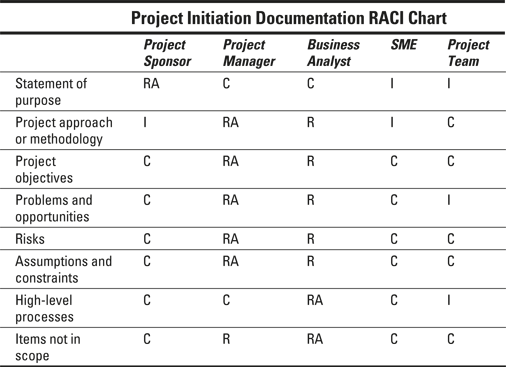
Project Initiation Documentation RACI Chart

Project Initiation Documentation RACI Chart

This is a RACI chart specifically for project initiation documentation — who’s responsible for producing each piece of the paperwork that kicks a project off. It’s based on the chart from Project Management for Dummies (Wiley, 2011), which is one of those books people laugh at but actually contains useful reference material. This particular chart maps out who does what during the initiation phase: the business case, the project brief, the risk register, the stakeholder analysis, and so on. ...

30 December 2014 · 1 min · 138 words · Shafiq Alibhai

Stakeholder RACI Matrix Spreadsheet

A RACI matrix stops the “I thought you were doing that” conversation before it starts. It’s a grid. Down the left side, you list the tasks or decisions. Across the top, you list the people or roles. Where they cross, you mark what each person’s relationship is to that item: R — Responsible. The person doing the work. A — Accountable. The person who owns the outcome and gets to say it’s done. C — Consulted. The person whose opinion matters before a decision is made. I — Informed. The person who needs to know after the decision is made. Why it matters The most common failure mode on a project isn’t that nobody does the work. It’s that two people think they’re both responsible, or nobody thinks they’re responsible at all. ...

28 December 2014 · 2 min · 350 words · Shafiq Alibhai

Break stakeholders into smaller groups according to roles or goals

Once you’ve got your stakeholder list — the one from the stakeholder list document, filled in with names, titles, and notes — the next step is to stop looking at it as a flat list and start grouping them. A flat list of twenty names is hard to work with. You can’t send the same email to everyone. You can’t run the same meeting with everyone. You can’t make the same promises to everyone. So you split them up. ...

15 December 2014 · 3 min · 536 words · Shafiq Alibhai

Stakeholder List Document

Every project has people who care about it, whether they’ve signed up for it or not. The trick is figuring out who they are before they start caring loudly. I keep a simple stakeholder list document open from day one. It’s not fancy — six columns, thirty-six rows, nothing more. But it stops you from being surprised when someone you never considered shows up at a steering group demanding answers. ...

8 December 2014 · 2 min · 356 words · Shafiq Alibhai