WHPH vs Super Productivity

I’ve been trying to figure out which productivity app actually fits my workflow. Both WHPH (Work Hard Play Hard) and Super Productivity keep coming up, so I thought it was worth comparing them properly. WHPH (Work Hard Play Hard) WHPH is a general-purpose productivity app. It does several things: tracks your tasks, monitors which apps you use and for how long, helps you build habits, and gives you a basic sense of where your time goes. The sync between desktop and mobile happens over your local network – no cloud, no account, just devices talking to each other. ...
29 September 2025 · 2 min · 355 words · Shafiq Alibhai

Starting a new contract — what I wish I'd asked sooner

I’ve been on enough contracts now that I’ve started noticing patterns. Some good, some not so good. This is a collection of the things I check before signing, and the things I wish someone had told me about earlier. Before you sign There are three administrative questions that can catch you out if you don’t sort them early. The first two are about checks — whether the client needs a BPSS or DBS check done, and whether they’re going to organise it. The third is about timing. Some start dates are real, others depend on the client actually getting you a laptop and sorting your access. If their setup process is slow, your start date slides whether they realise it or not. ...

22 May 2025 · 3 min · 567 words · Shafiq Alibhai

When a Problem Is Worth Solving

I used to take on any project that came my way. That was a mistake. Not every problem deserves your time, and not every client is worth working with. Over the years I’ve learned to filter opportunities through a simple set of questions before committing to anything. Can they fix it themselves? If the answer is yes – or if a decent blog post could solve it – then it’s not a consulting engagement. It’s a homework assignment. The value of consulting lies in the gap between what the client knows and what they need to know. Close that gap and you’ve got nothing to sell. ...

22 May 2025 · 2 min · 250 words · Shafiq Alibhai

Self-Promotion at Work

Self-promotion gets a bad reputation because people confuse it with boasting. Done well, it’s just making sure the right people know what you’ve done. Use “I” when it’s your work If you led the project, say “I led the project.” Saving “we” for genuinely collaborative work means your individual contributions stand out when they matter. Performance reviews are your moment If your organisation does annual reviews, prepare a list of accomplishments before the meeting. Don’t rely on your manager to remember everything you did over twelve months. ...

15 May 2025 · 2 min · 213 words · Shafiq Alibhai

Building a Second Brain

I’ve been reading Tiago Forte’s Building a Second Brain, and it’s one of those books that makes you immediately want to reorganise your entire digital life. The central idea is straightforward enough: your brain is for having ideas, not storing them. Everything else – notes, articles, voice memos, half-finished projects – should live somewhere external that you can trust and search. The framework he proposes is called CODE: Capture, Organise, Distill, Express. It’s simple, and that’s the point. Most people I know (myself included) are terrible at the first two steps. We capture everything – screenshots, highlights, random thoughts – and then we never look at it again because there’s no system for getting it out. ...

11 September 2024 · 4 min · 804 words · Shafiq Alibhai

Books that actually helped me with the people side of project management

I spent a chunk of last year reading my way through the soft-skills section of the bookshop. Not because I’d suddenly become interested in personal development — more because I was struggling with a project where the technical bits were fine but everything around it kept falling apart. Miscommunications. Teams that wouldn’t align. Stakeholders who seemed to be operating in a different reality. So I started reading. Not the textbook stuff, but the books people actually recommend when they’re being honest. Here’s what stuck. ...

5 September 2023 · 7 min · 1383 words · Shafiq Alibhai

Security Clearance Vetting for Access to Cloud Production Environments

Access to cloud production environments should require security clearance vetting. Production systems hold live data and applications, and the consequences of compromise are direct. UK clearance levels Level What it covers Checks included BPSS Pre-employment screening for government asset access Identity, employment history, immigration status, unspent criminal record AC Unescorted access to UK airport security areas Identity, employment history, criminal record, government agency records CTC / Level 1B UK OFFICIAL assets, occasional SECRET access Identity, employment, criminal record, financial situation, personal circumstances SC Substantial unsupervised SECRET access Everything in CTC plus credit reference and MI5 record checks DV Substantial unsupervised TOP SECRET access Everything in SC plus detailed interview and referee enquiries The process You need a sponsor — usually HR or a company security controller. They confirm your role requires vetting and that BPSS checks are complete (unless you’re doing AC). You then fill out a security questionnaire online covering personal details, employment history, finances, criminal record, foreign travel, and contacts. ...

11 July 2023 · 2 min · 258 words · Shafiq Alibhai

What DevOps Collaboration Actually Looks Like

I spent years watching development and operations teams sit on opposite sides of every incident. Developers pushed code over the wall. Operations inherited the fires. DevOps was supposed to fix that, but most teams just gave it a new name and kept doing the same thing. Real collaboration isn’t a poster on the breakroom wall. It’s the unglamorous daily work of making sure two groups who think differently about problems end up solving them together. ...

27 January 2023 · 4 min · 697 words · Shafiq Alibhai
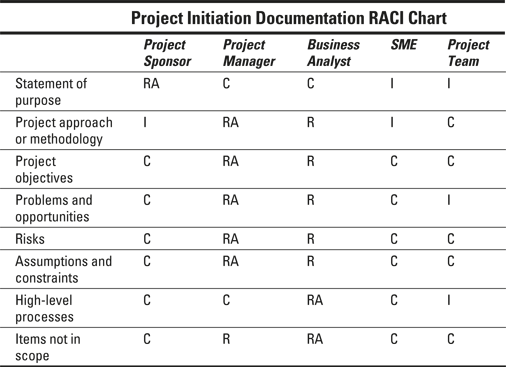
Project Initiation Documentation RACI Chart

Project Initiation Documentation RACI Chart

This is a RACI chart specifically for project initiation documentation — who’s responsible for producing each piece of the paperwork that kicks a project off. It’s based on the chart from Project Management for Dummies (Wiley, 2011), which is one of those books people laugh at but actually contains useful reference material. This particular chart maps out who does what during the initiation phase: the business case, the project brief, the risk register, the stakeholder analysis, and so on. ...

30 December 2014 · 1 min · 138 words · Shafiq Alibhai

Stakeholder RACI Matrix Spreadsheet

A RACI matrix stops the “I thought you were doing that” conversation before it starts. It’s a grid. Down the left side, you list the tasks or decisions. Across the top, you list the people or roles. Where they cross, you mark what each person’s relationship is to that item: R — Responsible. The person doing the work. A — Accountable. The person who owns the outcome and gets to say it’s done. C — Consulted. The person whose opinion matters before a decision is made. I — Informed. The person who needs to know after the decision is made. Why it matters The most common failure mode on a project isn’t that nobody does the work. It’s that two people think they’re both responsible, or nobody thinks they’re responsible at all. ...

28 December 2014 · 2 min · 350 words · Shafiq Alibhai